Introduction
Running casing in tight, deviated, or unstable formations often leads to high torque, drag, and stuck pipe risks. A reamer shoe is designed to solve these problems by combining guidance, reaming, and hole conditioning in one tool.
Installed at the casing or liner shoe track, a reamer shoe reams under-gauged sections, removes ledges, and improves hole geometry in real time during casing running. This capability is essential in deviated, horizontal, extended-reach, or unstable formations where conventional guide shoes or float shoes may lead to drag, sticking, or failure to reach TD.
What Does a Reamer Shoe Do?
The primary role of a reamer shoe in cementing operations is to condition the wellbore while running casing, ensuring smoother deployment and better cement placement. Key functions:
- Ream tight or under-gauged hole sections
- Reduce torque, drag, and stuck-pipe risks
- Enlarge effective borehole diameter
- Enhance cuttings evacuation via optimized circulation ports
- Guide the string reliably to target depth
These features minimize non-productive time and improve zonal isolation post-cementing.
Why Reamer Shoes Are Essential in Modern Wells
Complex trajectories and challenging formations increase wellbore irregularities. Traditional float shoes provide guidance and backflow prevention but lack mechanical reaming power.
A casing reamer shoe delivers proactive conditioning, resulting in:
- Greater success reaching TD on the first run
- Lower incidence of stuck casing
- Superior hole cleaning
- Reduced overall operational costs
This makes reamer shoes standard in horizontal, ERD, and high-angle wells.
Key Design Features of Reamer Shoes
High-performance reamer shoes incorporate:
- Wear-resistant elements — Tungsten carbide inserts and PDC cutters for abrasive environments
- Blade geometry — Optimized spiral or eccentric profiles for efficient cutting with controlled torque
- Circulation design — High-flow ports to prevent packing off and ensure effective debris removal
- Material balance — Robust construction for running loads combined with full drillability (PDC-compatible)
Types of Reamer Shoes – Alrunner™ Series by Newland Oiltools
The Alrunner™ series offers tailored solutions:
Alrunner™ Extreme For Severe Wellbore Conditions
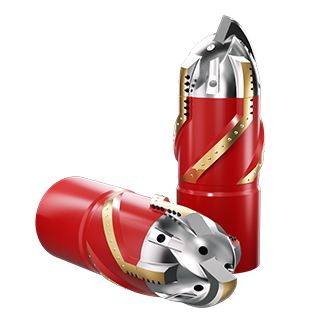
- Aggressive blade profile with integrated PDC cutters
- Eccentric aluminum bronze nose with tungsten carbide coating for improved wear resistance
- 360° spiral blade configuration with tungsten carbide inserts
- One-piece milled steel body for structural integrity
- Optimized circulation ports for efficient cuttings removal
- Equipped across the full product range with Newland's patented POLOVAL™ valve, delivering performance exceeding API 10F, 4th Edition requirements
- Designed for highly restrictive and abrasive formations, where conventional shoes fail to reach TD.
Key benefits:
- Aggressive PDC cutting structure for maximum reaming capability
- Enhanced wear resistance for long sections
- Reliable performance in ERD and horizontal wells
Alrunner™ Force Balanced for moderate challenges
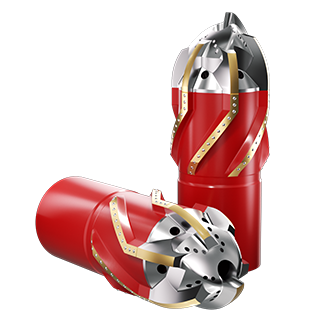
- Aggressive blade design for effective reaming
- Eccentric aluminum nose with CNC-machined blades for improved wear resistance
- 360° spiral blade design with tungsten carbide inserts
- One-piece milled steel body
- Optimized circulation ports for effective hole cleaning
- Equipped across the full product range with Newland's patented POLOVAL™ valve, delivering performance exceeding API 10F, 4th Edition requirements
Alrunner™ Standard Light conditioning with float functionality
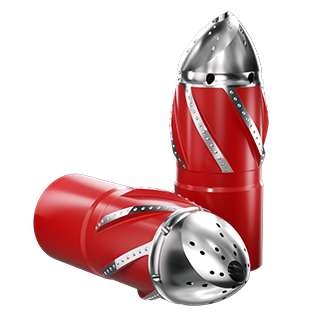
- Aggressive blade design for light to moderate reaming
- Eccentric aluminum nose
- 360° spiral blade configuration with tungsten carbide inserts
- One-piece milled steel body
- Optimized circulation ports for improved hole cleaning
- Equipped across the full product range with Newland's patented POLOVAL™ valve, delivering performance exceeding API 10F, 4th Edition requirements
Reamer Shoe vs Float Shoe – Comparison
Tool | Primary Functions | Reaming/Conditioning | Typical Applications |
Float Shoe | Guides casing + check valve for cement placement | None | Simple vertical or low-risk wells |
Reamer Shoe | Guides + reams tight spots + conditions wellbore | High | Deviated, tight, irregular holes |
Why Upgrade from Float Shoe to Reamer Shoe?
- Eliminates need for pre-reaming trips
- Reduces risk of stuck casing
- Improves first-run success rate
- Saves rig time and operational cost
Common Applications in Oilfield Cementing
- Deviated and horizontal sections
- Under-gauged or ledged intervals
- Swelling shales or unstable formations
- Operations requiring enhanced hole cleaning during casing run
Testing and Quality Assurance for Reamer Shoes
Reliable reamer shoe performance demands rigorous validation beyond design. Industry-standard tests for float-equipped reamer shoes follow API RP 10F guidelines, including:
- Extended mud circulation endurance (e.g., high-rate flow for 24+ hours to simulate downhole conditions)
- High-temperature exposure followed by backpressure holding (e.g., 400°F soak then 10,000+ psi differential)
- Valve integrity and pressure retention (for models with float valves)
- Structural and material checks for drillability and durability
At Newland Oiltools, we prioritize quality from raw materials onward: high-grade seamless pipes undergo chemical composition and mechanical property verification. Each tool receives a unique serial number at processing start for complete traceability back to the raw material batch.
Our dedicated high-precision machining line—developed in partnership with specialized lathe manufacturers—eliminates common issues like thread vibration. Strict process inspections, especially zero-defect thread gauging, ensure consistency.
For functional validation, we operate a full mud circulation test system that simulates real well conditions (flow, pressure, temperature). This allows testing to the latest API 10F standards (including Category IIIC-level endurance and pressure) as well as customized programs for client-specific requirements—delivering proven reliability downhole without compromise.
FAQ
A: In deviated wells, under-gauged sections, ledges, or where hole cleaning issues are anticipated during casing running.
Conclusion
Though compact, a reamer shoe significantly enhances casing running success and cement job quality by overcoming wellbore restrictions that standard tools cannot address. Selecting the right Alrunner™ configuration—paired with centralizers,float collars, and guide shoes—helps operators minimize risks and NPT.
Contact Newland Oiltools for technical specs, well-specific recommendations, or Alrunner™ series support.